Trying times bring out the best and the worst in people and these are trying times indeed...
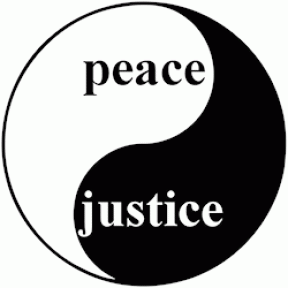 There seems a lot of opinions out there as regards the peace process. As I too am committed to the peace process, let me express some of my own.
The peace we want to accomplish through the peace process must ultimately be a human peace; the justice of this peace in its ideal form being a restoration of our unity as a human community.
To me, a "human peace" is simply one that restores dignity to the life of a community and since the peace that we are negotiating across the board is a national proposition - this peace must be capable of restoring dignity to the life of all our communities in the nation - across the Republic of the Philippines.
Will the peace in Mindanao affect things in Batanes? Of course, it must! A human peace is one that is able to provide for the human needs of a community. As a Republic, we are this community, this one house!
To do justice to the temporal house of the one Filipino nation is to make it one as our soul is one. To remain in our souls divided in war is to choose as a nation to remain in a state of spiritual injustice.
The essence of our civics is to do unto each other good.
For in this Country, we all must be free and unafraid to do good to our fellow Filipino.
A human peace allows us the space, across our generations, to preserve both our freedom and our hope, in all things good and worthwhile to and for the Filipino... To desire this peace, to me, is therefore, always a good thing. For it shelters and protects our national communities from war (often in more ways than one).
What happened?
From the Nation to the State, we have to introduce words to articulate something true about ourselves and, my brothers and sisters, words always exclude. Indeed, words both limit and exclude. Therefore, peace as its human expression may be intensely political - most especially if our remembrances about it as a nation are not yet as mature.
Observe however, how a lot of Filipinos think war is not the answer - that is good. It means the spirit of our memory is being restored unto us... we just have to articulate it properly in the State.
The BBL is one such proposed articulation of how we may as one Filipino nation be restored to the unity of our peace. It is certainly not a perfect document. I myself have several things I should like to be able to clarify about it.
The BBL is a result of a long process... One should at least respect the hope that is invested in this document which is a hope for peace; a hope that if expressed correctly in the State may never go wrong.
I am NOT for war. Indeed, I am absolutely against any forms of "all-out war" - in any place, at any time. I am definitely for the peace - in particular here in our Philippines.
However, I must accept the path unto the threshold of this peace is political. Also, that the politics of a peace process will not readily confer justice in the temporal sense but initially serve to deflect the onset of more evil days. In Syria and the Ukraine, this for me is also true.
What justice we may work out shall be the justice of our sincerity in desiring peace and desiring peace absolutely - with a maturity of remembrance.
In general, the goal of our local peace process is to restore spiritual justice to the Philippine State that the State may then proceed to bestow temporal justice in behalf of all its citizens.
Justice in its fullness we can not deny ourselves.
Our nation has a responsibility to possess in its soul an account to God of all human life.
This means as citizens, we are responsible both for and to the memory of all Filipinos the Providence of God hath vouchsafed to be born into our nationhood - through a living and present account of each and every single one of our names. This is our common debt of remembrance to God and Country, a burden of Justice which is part of our responsible Liberty.
We can not remember them all singly but as a nation we must remember them all fully.
And through a memory of their lives and sacrifices - live! Indeed, prosper and live! This "live" is the essence of our "mabuhay" which exhorts us to live the memory - therefore, long live the memory!
Maturity of remembrance understands the "intrinsic value" of each and every human life and detests war for what it is, understanding peace.
A State that is fully accepting of peace in spirit proceeds from this truth not so much with law but with liberty. However, as we are wounded by so much internal strife, we need a cast to bind our bones to make them whole and strong again... We may liken the provision that establishes the CAR and the ARMM as such a cast. If the cast is not working, maybe it needs remolding.
Such is our quest for peace here in our Country...
We do not seek a perfect peace. It is impossible to attain peace in its perfection in this world at its state. But we may anchor our peace upon principles timeless and absolute and live its lineage unto truth and the victory of the Truth.
Our temporal dominion as a Republic here in this world may never be as perfect as our loves desire but if in our hearts we understand how we are united as one national community and if in our communities we know how we may live this unity and the hope of this unity in freedom... I think we all will be well.
Peace making involves trust. This means accepting risks. These risks are the same risks we normally subject our nation to when we choose to default to war and distrust.
Peace is an enlightened choice not to accept the status quo of this world and one we make as a nation - because we finally understand.
What does this mean?
When we speak of the peace process, sincerity above all matters most of all.
Even before the politics of everything, I think when we seek peace we must seek peace absolutely.
Appeasement of war bring more war and doing things in behalf of peace short of a true desire for peace is harmful simply because it is untrue... For the peace we all hope to establish among ourselves shall ultimately be tested by its fruits... a peace for all Filipinos.
Let us review in spirit the peace we are after. Let us have these reference points from each shore before we wade into deeper water... that the bridges we may seek to build - together this time - may be strong and straight and nevermore skewed.
The rest we shall attend to as things unfold... for we are creatures caught up in time after all... change is our right and our responsibility.
Let us be patient. Let us be understanding. Let us be above all, firm.
Peace is over war. For war is not for always. But unity is eternal.
God love the Philippines. Mabuhay po tayong lahat.
---<--@

In the midst of all of these, in this Lenten season, I should like to remind my fellow Filipino Catholics to come back to a meditation on the Year of the Poor which is this year, 2015.
Let us work and pray that the Holy Spirit this year carry our nation forth into waters safer and vistas brighter.
A little personal anecdote:
Smile the Pope Francis smile: When I look at how our Holy Father smiles, I feel the warmth - the gold of the smile! One of the things I can not forget about our Holy Father is his smile. Isn't smiling like this a form of charity?
We love you Holy Father Francis!
The peace we want to accomplish through the peace process must ultimately be a human peace; the justice of this peace in its ideal form being a restoration of our unity as a human community.
To me, a "human peace" is simply one that restores dignity to the life of a community and since the peace that we are negotiating across the board is a national proposition - this peace must be capable of restoring dignity to the life of all our communities in the nation - across the Republic of the Philippines.
Will the peace in Mindanao affect things in Batanes? Of course, it must! A human peace is one that is able to provide for the human needs of a community. As a Republic, we are this community, this one house!
To do justice to the temporal house of the one Filipino nation is to make it one as our soul is one. To remain in our souls divided in war is to choose as a nation to remain in a state of spiritual injustice.
The essence of our civics is to do unto each other good.
For in this Country, we all must be free and unafraid to do good to our fellow Filipino.
A human peace allows us the space, across our generations, to preserve both our freedom and our hope, in all things good and worthwhile to and for the Filipino... To desire this peace, to me, is therefore, always a good thing. For it shelters and protects our national communities from war (often in more ways than one).
What happened?
From the Nation to the State, we have to introduce words to articulate something true about ourselves and, my brothers and sisters, words always exclude. Indeed, words both limit and exclude. Therefore, peace as its human expression may be intensely political - most especially if our remembrances about it as a nation are not yet as mature.
Observe however, how a lot of Filipinos think war is not the answer - that is good. It means the spirit of our memory is being restored unto us... we just have to articulate it properly in the State.
The BBL is one such proposed articulation of how we may as one Filipino nation be restored to the unity of our peace. It is certainly not a perfect document. I myself have several things I should like to be able to clarify about it.
The BBL is a result of a long process... One should at least respect the hope that is invested in this document which is a hope for peace; a hope that if expressed correctly in the State may never go wrong.
I am NOT for war. Indeed, I am absolutely against any forms of "all-out war" - in any place, at any time. I am definitely for the peace - in particular here in our Philippines.
However, I must accept the path unto the threshold of this peace is political. Also, that the politics of a peace process will not readily confer justice in the temporal sense but initially serve to deflect the onset of more evil days. In Syria and the Ukraine, this for me is also true.
What justice we may work out shall be the justice of our sincerity in desiring peace and desiring peace absolutely - with a maturity of remembrance.
In general, the goal of our local peace process is to restore spiritual justice to the Philippine State that the State may then proceed to bestow temporal justice in behalf of all its citizens.
Justice in its fullness we can not deny ourselves.
Our nation has a responsibility to possess in its soul an account to God of all human life.
This means as citizens, we are responsible both for and to the memory of all Filipinos the Providence of God hath vouchsafed to be born into our nationhood - through a living and present account of each and every single one of our names. This is our common debt of remembrance to God and Country, a burden of Justice which is part of our responsible Liberty.
We can not remember them all singly but as a nation we must remember them all fully.
And through a memory of their lives and sacrifices - live! Indeed, prosper and live! This "live" is the essence of our "mabuhay" which exhorts us to live the memory - therefore, long live the memory!
Maturity of remembrance understands the "intrinsic value" of each and every human life and detests war for what it is, understanding peace.
A State that is fully accepting of peace in spirit proceeds from this truth not so much with law but with liberty. However, as we are wounded by so much internal strife, we need a cast to bind our bones to make them whole and strong again... We may liken the provision that establishes the CAR and the ARMM as such a cast. If the cast is not working, maybe it needs remolding.
Such is our quest for peace here in our Country...
We do not seek a perfect peace. It is impossible to attain peace in its perfection in this world at its state. But we may anchor our peace upon principles timeless and absolute and live its lineage unto truth and the victory of the Truth.
Our temporal dominion as a Republic here in this world may never be as perfect as our loves desire but if in our hearts we understand how we are united as one national community and if in our communities we know how we may live this unity and the hope of this unity in freedom... I think we all will be well.
Peace making involves trust. This means accepting risks. These risks are the same risks we normally subject our nation to when we choose to default to war and distrust.
Peace is an enlightened choice not to accept the status quo of this world and one we make as a nation - because we finally understand.
What does this mean?
When we speak of the peace process, sincerity above all matters most of all.
Even before the politics of everything, I think when we seek peace we must seek peace absolutely.
Appeasement of war bring more war and doing things in behalf of peace short of a true desire for peace is harmful simply because it is untrue... For the peace we all hope to establish among ourselves shall ultimately be tested by its fruits... a peace for all Filipinos.
Let us review in spirit the peace we are after. Let us have these reference points from each shore before we wade into deeper water... that the bridges we may seek to build - together this time - may be strong and straight and nevermore skewed.
The rest we shall attend to as things unfold... for we are creatures caught up in time after all... change is our right and our responsibility.
Let us be patient. Let us be understanding. Let us be above all, firm.
Peace is over war. For war is not for always. But unity is eternal.
God love the Philippines. Mabuhay po tayong lahat.
---<--@
In the midst of all of these, in this Lenten season, I should like to remind my fellow Filipino Catholics to come back to a meditation on the Year of the Poor which is this year, 2015.
Let us work and pray that the Holy Spirit this year carry our nation forth into waters safer and vistas brighter.
A little personal anecdote:
Smile the Pope Francis smile: When I look at how our Holy Father smiles, I feel the warmth - the gold of the smile! One of the things I can not forget about our Holy Father is his smile. Isn't smiling like this a form of charity?
We love you Holy Father Francis!


.jpg)


